Why VBPV Transforms UK Solar Strategy
Vertical Bifacial PV systems eliminate the false choice between energy security and food security — delivering superior performance across every metric that matters for the UK.
Superior Energy Output
VBPV generates 19–22% more annual energy than conventional tilted systems, with peak generation aligning to morning and evening demand — not midday when prices are lowest. Winter gains reach +24.52%.
Farmland Preserved
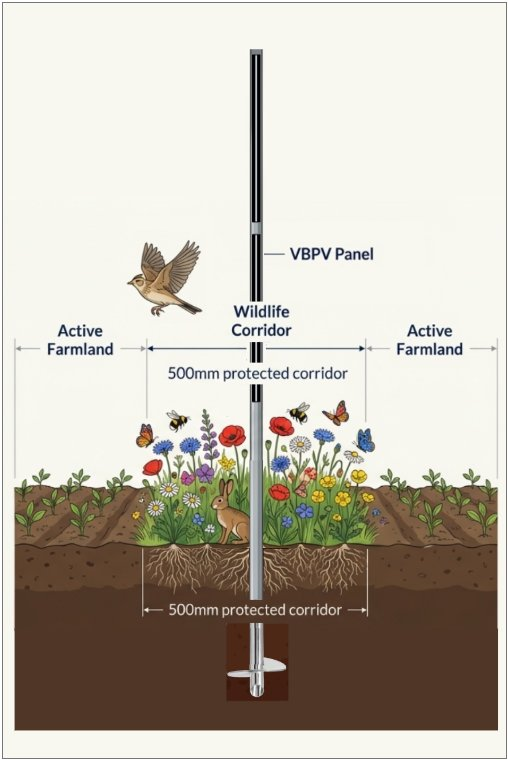
With 10–12m row spacing and 500mm posts occupying less than 5% of ground coverage, standard agricultural machinery operates freely. 80–90% of crop productivity is maintained alongside energy generation.
Grid Costs Reduced
Morning and evening generation peaks align 18% better with UK demand patterns, reducing the need for expensive battery storage and grid reinforcement. System savings of £25–35bn across the UK pipeline.
Biodiversity Enhanced
Wildflower strips sown beneath each VBPV panel row provide nectar and pollen for bumblebees, butterflies and hoverflies, whilst attracting ladybirds, parasitoid wasps and predatory beetles that naturally suppress aphids in adjacent crops. Peer-reviewed field research confirms this is compatible with continued arable production — and directly supports mandatory Biodiversity Net Gain (BNG) obligations.
Revenue Premium
VBPV generates during the 07:00–11:00 and 17:00–21:00 demand peaks when wholesale electricity prices are 25–40% higher than at midday. This translates to 10–15% higher revenue per kWh compared to conventional solar — on top of the 19–22% output advantage.
Conventional tilted solar floods the grid at midday, driving price cannibalisation. VBPV's east-west orientation naturally avoids this, producing a morning peak and an evening peak that closely track household and industrial demand — making every unit generated worth more.
The dual advantage of higher output and higher revenue per kWh makes VBPV significantly more attractive to investors and CfD bidders than the headline capacity figures suggest.
Planning Compatible
VBPV's agricultural compatibility directly addresses the core objection raised by local authorities, communities, and the NFU — that solar farms remove productive farmland from the food supply chain. With 80–90% of land remaining in active cropping, this objection is substantially neutralised.
Standard agricultural machinery operates between the rows without modification. Existing farm tenancy arrangements, crop rotations, and agri-environment scheme eligibility can be maintained — removing the planning friction that currently delays or defeats conventional solar proposals.
For NSIPs and Section 78 appeals, VBPV's dual land-use case offers a compelling response to Inspectors weighing energy need against agricultural land protection under the NPPF.